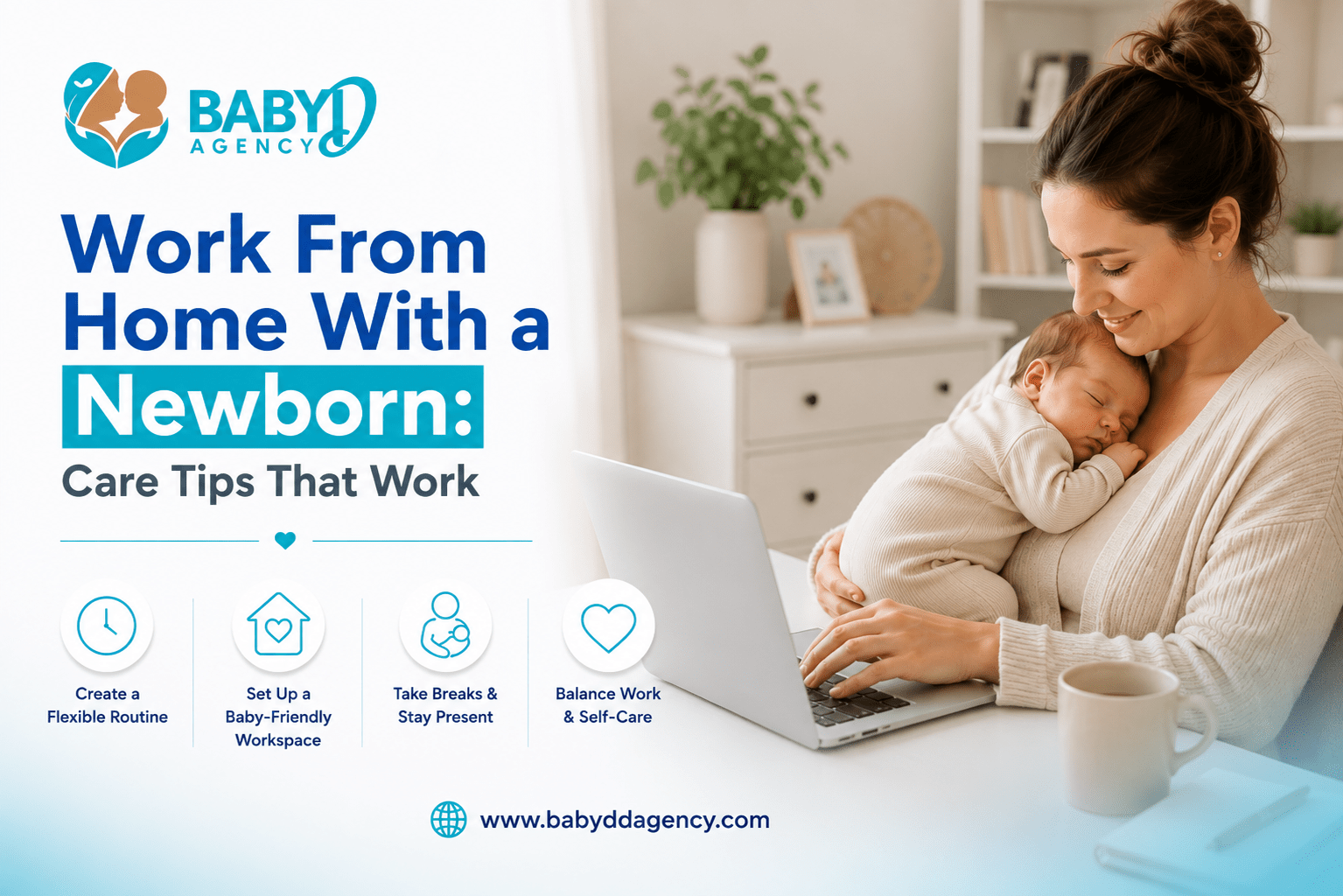
Remote work was supposed to make life easier for Families in Transition. In some ways it does, no commute, more flexibility for appointments, fewer logistics around pickups. But trying to work from home with a newborn is its own particular challenge, one that flexibility alone doesn’t solve.
- What the Research Actually Says About Working From Home With a Newborn
It’s tempting to assume remote work automatically eases the strain of newborn care for working parents, but recent data tells a more complicated story. A 2026 Pew Research Center survey of over 2,200 U.S. working parents found that parents who work from home all or most of the time are about as likely as those who rarely work remotely to say balancing work and family responsibilities is difficult. Remote work changes where the juggling happens, but it doesn’t remove the need to juggle, especially with an infant who can’t be handed a screen or asked to wait.
The same research found that a majority of working parents regularly handle parenting tasks while working and work tasks while parenting, a pattern that becomes especially intense in the newborn stage, when feeding and care needs happen every two to three hours around the clock.
- Why Newborns Make Remote Work Uniquely Hard
Older children can occupy themselves for stretches of time. Newborns cannot. A baby’s needs are frequent, unpredictable, and non-negotiable, which makes the usual remote-work strategy of “working in the gaps” much harder to pull off during the first weeks and months. Add postpartum recovery and sleep deprivation into the mix, and it’s easy to see why so many parents describe the newborn stage as the hardest period to work from home, not the easiest.
- Practical Tips to Work From Home With a Newborn
Build a realistic schedule, not an ideal one
Rather than mapping your workday around a full eight hours, plan around your baby’s actual patterns. Many newborns have a longer stretch of sleep once or twice a day, block your most demanding tasks around those windows rather than assuming a fixed 9-to-5 will hold.
Communicate expectations early with your employer
Being upfront about needing flexible hours, or a phased return, tends to go better than trying to quietly power through and burning out. If your workplace offers phased return-to-work options or flexible scheduling, use them.
Separate “with baby” work from “focus” work
Tasks like responding to emails or attending calls with a baby napping nearby are far more realistic than deep, uninterrupted focus work. Save the tasks that need real concentration for windows when you have backup support.
Get comfortable with imperfect boundaries
The idea of a perfectly separated work life and home life rarely survives contact with a newborn. Many parents find it easier to expect some overlap, and build in ways to recover afterward, rather than aiming for a boundary that isn’t realistic during this stage.
Don’t go it alone
This is the single biggest lever most families underuse. Trying to be a full-time remote employee and a full-time newborn caregiver simultaneously, without support, is a recipe for burnout for even the most organized parent.
- Newborn Care for Working Parents: Where Professional Support Fits
This is exactly where dedicated newborn care changes the math. A Transition Specialist can take over feeding, soothing, and nap schedules during work hours, giving parents actual blocks of uninterrupted time rather than constantly split attention. Instead of taking a work call while bouncing a fussy baby, parents working from home with support can close the door, focus, and know their baby is in capable hands nearby.
For families balancing two remote jobs, or a remote job alongside postpartum recovery, this kind of support often makes the difference between a sustainable setup and a burnout cycle.
- Building a Sustainable Routine
A few structural choices help long term:
- Set a “start” and “end” ritual for the workday, even a short walk or a specific task, to mentally separate work mode from parenting mode.
- Protect at least one predictable support window each day, whether that’s a partner, a family member, or a Transition Specialist, so you know you have real focus time.
- Revisit the plan every few weeks. A newborn’s schedule changes constantly in the first few months, and a routine that worked in week two may need adjusting by week eight.
- Track what’s actually working, not what you think should work. Flexibility to adjust matters more than sticking to a rigid plan.
Conclusion
Working from home with a newborn is genuinely difficult, and research increasingly confirms that flexibility alone doesn’t erase the strain of caregiving. Building a realistic schedule, communicating openly with your employer, and bringing in dedicated newborn care support are the strategies that actually make this stage sustainable, rather than just quieter to talk about.
- FAQ
Q: Does working from home actually make things easier for Families in Transition?
A: Research suggests it helps in some ways, more flexibility for appointments and less commuting time, but it does not eliminate the core difficulty of balancing work and caregiving, especially with a newborn.
Q: How can I focus on work with a newborn at home?
A: Plan demanding tasks around your baby’s more predictable sleep windows, and consider bringing in support, whether a partner, family member, or Transition Specialist, during your most critical work hours.
Q: Is it normal to feel like I can’t fully focus on either work or parenting?
A: Yes, this is an extremely common experience for parents working from home with a young baby, and it tends to ease as routines become more established.
Q: What does newborn care for working parents typically include?
A: It usually covers feeding, soothing, sleep routines, and daytime care during work hours, allowing parents to have dedicated, uninterrupted blocks of time.
Q: When should I consider hiring support to work from home with a newborn?
A: If you’re consistently unable to complete focused work, feeling burned out, or lack nearby family support, bringing in a Transition Specialist earlier rather than later tends to prevent burnout instead of just responding to it.