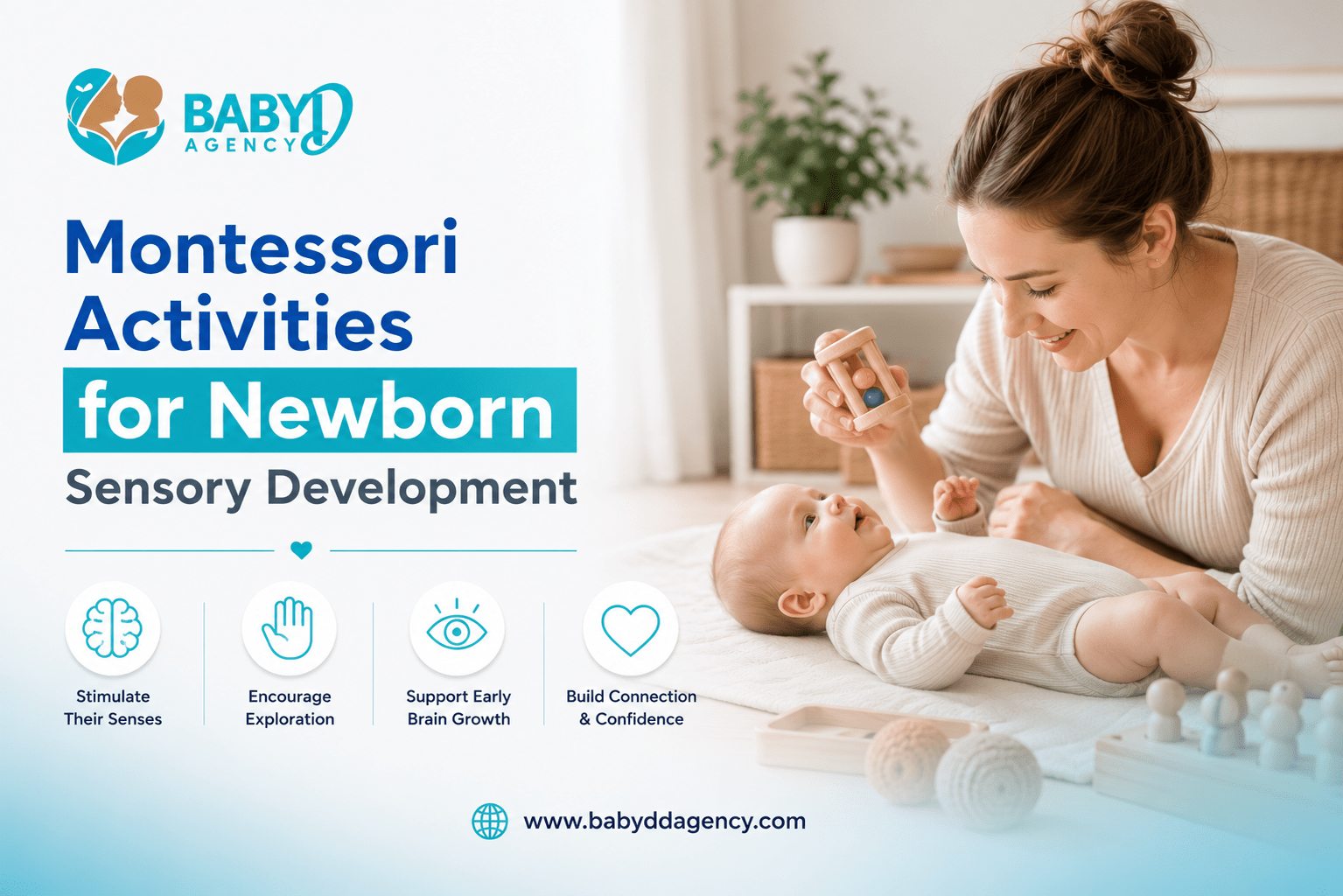
Montessori is often associated with preschool classrooms full of wooden puzzles and child-sized furniture, but its principles apply just as much to the earliest weeks of life. Simple, intentional Montessori activities for newborns can support sensory development from day one, long before a baby can sit up, grasp a toy, or make eye contact on cue.
- Why Newborn Sensory Development Matters So Early
A newborn’s brain is doing an enormous amount of work in the first months of life, building the neural connections that shape how they process sound, sight, touch, and movement for years to come. Harvard University’s Center on the Developing Child describes early brain architecture as being built through consistent, responsive experiences between a baby and the caregivers around them, exactly the kind of intentional, back-and-forth interaction Montessori practice emphasizes from birth.
This is part of why Montessori-inspired newborn care focuses less on flashy toys and more on calm, predictable sensory experiences that a baby can actually process and respond to.
- Core Montessori Principles Behind Newborn Sensory Development
A few ideas guide Montessori-inspired care of infants:
- Less is more. A calm, uncluttered environment lets a newborn focus on one sensory experience at a time instead of being overwhelmed by stimulation.
- Follow the baby’s lead. Newborns communicate readiness and overstimulation through subtle cues, turning away, fussing, or going still. Montessori practice treats these cues as meaningful information, not something to push through.
- Real experiences over passive entertainment. Natural light, human faces, textured fabric, and the caregiver’s voice offer richer sensory input than screens or overstimulating toys.
- Respect for the baby as a capable participant. Even a newborn is treated as an active participant in their own development, not simply a passive recipient of care.
Simple Montessori Activities for Newborns by Sense
Sight
High-contrast black-and-white images or simple mobiles are particularly effective in the first two to three months, since a newborn’s vision is still developing and strong contrast is easier to focus on than pastel colors. Placing these within 8 to 12 inches of your baby’s face, their natural focal distance, gives them something achievable to track.
Sound
Talking to your baby throughout the day, narrating what you’re doing, naming objects, singing softly, builds early language exposure in a way that feels natural rather than performative. Gentle, varied sounds (a soft rattle, different tones of voice) also help newborn sensory development without overwhelming an immature auditory system.
Touch
Skin-to-skin contact, different fabric textures during tummy time, and gentle massage all give a newborn rich tactile input. Montessori-inspired care often introduces simple textured materials, a soft ribbon, a piece of silk, a wooden ring, one at a time so a baby can explore without sensory overload.
Movement
Rather than restrictive equipment like bouncers or swings for long stretches, Montessori practice favors giving babies floor time and freedom to move their limbs. This supports the development of core strength and body awareness far more than being strapped into a seat.
Smell and Taste
Even in the newborn stage, gentle sensory input like the smell of a parent or a favorite blanket helps a baby build a sense of familiarity and security, an early foundation for the more active exploration that comes later.
- Building a Montessori-Inspired Environment at Home
You don’t need a dedicated nursery redesign to bring these principles into daily life. A few practical steps:
- Set up a simple floor space for supervised tummy time and movement, free of excess toys or clutter.
- Choose a handful of high-contrast or textured items rather than a large rotating toy collection.
- Narrate your day out loud, even simple things like “I’m changing your diaper now” build language exposure.
- Watch for overstimulation cues and follow your baby’s pace rather than a set schedule of activities.
- Prioritize real interaction over background noise, screens and constant stimulation can actually work against the calm, focused engagement Montessori principles are built around.
How Montessori-Trained Transition Specialists Help
Bringing Montessori principles into everyday newborn care takes more than good intentions, it takes consistency, which is hard to maintain in the sleep-deprived early weeks. A Transition Specialist trained in Montessori-inspired methods can weave these sensory practices into daily routines, feeding, tummy time, and settling, so they become a natural part of your baby’s day rather than one more thing on a parent’s to-do list.
- Conclusion
Montessori activities for newborns don’t require expensive materials or a complicated setup, they’re built on consistency, calm sensory input, and treating even the youngest babies as active participants in their own development. Supporting newborn sensory development in these early months lays groundwork that carries forward well beyond infancy.
- FAQ
Q: What age can I start Montessori activities for newborns? A: Montessori-inspired sensory practices, like high-contrast visuals, gentle textures, and responsive talking, can begin from birth, adjusted to what a newborn can comfortably process.
Q: What are the best Montessori toys for newborn sensory development? A: Simple, natural materials work best: high-contrast black-and-white cards or mobiles, soft textured fabrics, and wooden rattles, rather than battery-powered or overstimulating toys.
Q: How is Montessori different from typical newborn play? A: Montessori emphasizes fewer, more intentional sensory experiences and following the baby’s cues, rather than constant stimulation or entertainment-focused toys.
Q: Can too much sensory stimulation be harmful for a newborn? A: Overstimulation can lead to fussiness or difficulty settling. Montessori practice encourages watching for cues like turning away or fussing and scaling back stimulation accordingly.
Q: Do I need special training to use Montessori methods with my newborn? A: No, many principles are simple to apply at home. For families who want more structured support, a Transition Specialist trained in Montessori-inspired care can help build these practices into daily routines.